|
Jharkhand Staff Selection Commission (JSSC) – Jharkhand Assistant Jailor Competitive Examination-2025 (JAJCE-2025)
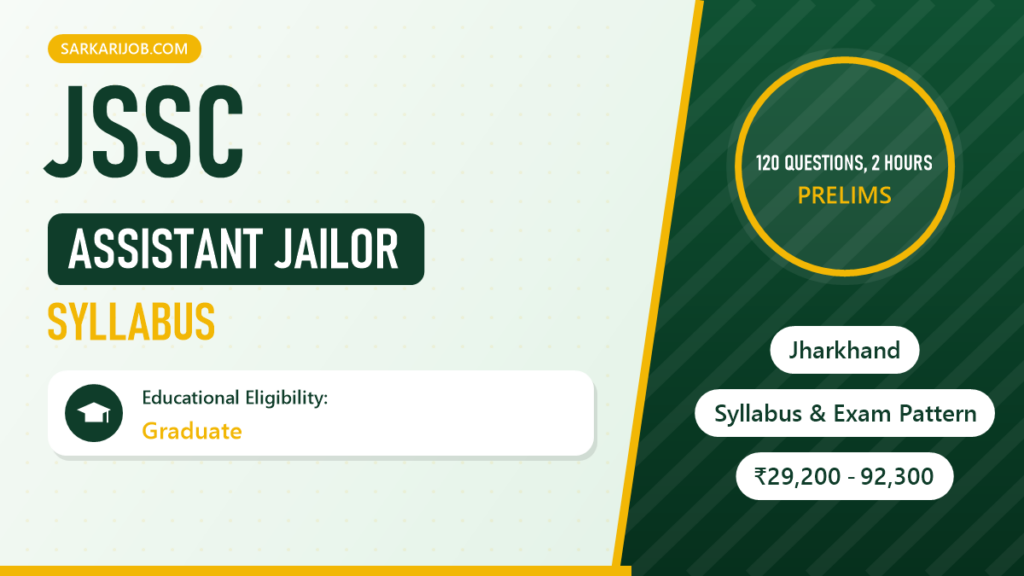
JSSC Assistant Jailor Syllabus and Exam Pattern 2026
Short Details of Notification
Sarkari Job
|
Exam Overview
- Based on : JSSC Advertisement No. 05/2025 dated 25/09/2025 and the JAJCE-2025 brochure (Regular); the Backlog brochure (Advertisement No. 06/2025) has the same scheme and syllabus
- Conducting Body : Jharkhand Staff Selection Commission (JSSC), Ranchi; the physical test and the medical test are held by selection boards and medical boards under the Jharkhand Assistant Jailor Cadre Rules 2012
- Post : Assistant Jailor (सहायक कारापाल), Group C non-gazetted; 42 regular posts under Advertisement 05/2025 and 3 backlog posts under Advertisement 06/2025
- Stages : Physical Efficiency Test (शारीरिक दक्षता परीक्षण) → Written Exam (लिखित परीक्षा) : Prelims (प्रारंभिक परीक्षा) and Mains (मुख्य परीक्षा) → Medical Test (चिकित्सीय जाँच) → Document Verification
- Mode : OMR or CBT; all questions objective multiple choice; questions in Hindi and English, except the language subjects
- Prelims : normally not held when fewer than 50,000 candidates pass the physical test; JSSC may hold the Mains directly even with more candidates
- Pay : Pay Matrix Level 5, ₹29,200 – 92,300
|
Exam Pattern |
Prelims (प्रारंभिक परीक्षा) : General Knowledge (सामान्य ज्ञान) |
| Part | Subject | Questions | Marks |
| (i) | General Studies (सामान्य अध्ययन) | 30 | 3 each |
| (ii) | Knowledge related to Jharkhand State (झारखण्ड राज्य से संबंधित ज्ञान) | 60 | 3 each |
| (iii) | General Mathematics (सामान्य गणित) | 10 | 3 each |
| (iv) | General Science (सामान्य विज्ञान) | 10 | 3 each |
| (v) | Mental Ability Test (मानसिक क्षमता जाँच) | 10 | 3 each |
- Total 120 questions in 2 hours; 3 marks for each correct answer and 1 mark cut for each wrong answer
- On the Prelims marks, 15 times the total vacancies go to the Mains; more candidates of a category are called if that category has fewer than 15 times its vacancies, and everyone with marks equal to the last selected candidate also goes
|
Mains (मुख्य परीक्षा) : 3 Papers |
| Paper | Subject | Questions | Marks |
| Paper 1 (क) | Hindi Language Knowledge (हिन्दी भाषा ज्ञान) | 60 | 3 each |
| Paper 1 (ख) | English Language Knowledge (अंग्रेजी भाषा ज्ञान) | 60 | 3 each |
| Paper 2 | Tribal and Regional Language (चिन्हित जनजातीय एवं क्षेत्रीय भाषा), any one language | 100 | 3 each |
| Paper 3 (क) | General Studies (सामान्य अध्ययन) | 30 | 3 each |
| Paper 3 (ख) | General Science (सामान्य विज्ञान) | 20 | 3 each |
| Paper 3 (ग) | General Mathematics (सामान्य गणित) | 20 | 3 each |
| Paper 3 (घ) | Mental Ability Test (मानसिक क्षमता जाँच) | 20 | 3 each |
| Paper 3 (ङ) | Computer Knowledge (कम्प्यूटर का ज्ञान) | 20 | 3 each |
| Paper 3 (च) | Knowledge related to Jharkhand State (झारखण्ड राज्य से संबंधित ज्ञान) | 40 | 3 each |
- Paper 1 Language Knowledge (भाषा ज्ञान) : 120 questions; Paper 2 : 100 questions; Paper 3 General Knowledge (सामान्य ज्ञान) : 150 questions
- Each paper is of 2 hours; the Mains is held in three shifts; 3 marks for each correct answer and 1 mark cut for each wrong answer
- Paper 1 is qualifying only : 30% of the Hindi and English marks taken together; these marks are not added for the merit list
- Paper 2 and Paper 3 : 30% marks needed in each
- Below 30% in Paper 1 : Paper 2 and Paper 3 are not checked; below 30% in Paper 2 : Paper 3 is not checked
- Minimum marks in the Prelims and Mains for the merit list : Unreserved 40%, SC / ST and Women 32%, Extremely Backward Class (Annexure-I) 34%, Backward Class (Annexure-II) 36.5%, Primitive Tribe 30%, EWS 40%
- Marks are normalised when the exam is held in several groups; the merit list uses the normalised marks
- Equal marks : the older candidate ranks higher; with the same date of birth, higher marks in Matric / 10th decide
|
Detailed Syllabus |
Prelims and Mains Paper 3 : General Studies (सामान्य अध्ययन)
- General awareness and its use in society, current events and a scientific view of everyday happenings, as expected of an educated person; questions mainly on Jharkhand, India and the neighbouring countries
- Current affairs (सम–सामयिक विषय), scientific progress (वैज्ञानिक प्रगति), national / international awards (राष्ट्रीय/अंतर्राष्ट्रीय पुरस्कार), Indian languages (भारतीय भाषाएँ), books (पुस्तक), scripts (लिपि), capitals (राजधानी), currencies (मुद्रा), sports and players (खेल–खिलाड़ी), important events (महत्त्वपूर्ण घटनाएँ)
- History of India (भारत का इतिहास), culture (संस्कृति), geography (भूगोल), environment (पर्यावरण), economic scene (आर्थिक परिदृश्य), freedom movement (स्वतंत्रता आंदोलन), main features of Indian agriculture and natural resources (भारतीय कृषि तथा प्राकृतिक संसाधनों की प्रमुख विशेषताएँ)
- Constitution of India and polity (भारत का संविधान एवं राज्य व्यवस्था), political system of the country (देश की राजनीतिक प्रणाली), Panchayati Raj (पंचायती राज), community development (सामुदायिक विकास), Five Year Plan (पंचवर्षीय योजना), general knowledge of the geographical and political situation of Jharkhand (झारखण्ड राज्य की भौगोलिक स्थिति एवं राजनीतिक स्थिति की सामान्य जानकारी)
|
Prelims and Mains Paper 3 : Jharkhand State Knowledge (झारखण्ड राज्य से संबंधित ज्ञान)
- Jharkhand’s geography (भूगोल), history (इतिहास), civilisation (सभ्यता), culture (संस्कृति), language and literature (भाषा–साहित्य), places (स्थान), mines and minerals (खान खनिज), industries (उद्योग), Jharkhand’s contribution to the national movement (राष्ट्रीय आंदोलन में झारखण्ड का योगदान), development schemes (विकास योजनाएँ), sports and players (खेल–खिलाड़ी), personalities (व्यक्तित्व), civic achievements (नागरिक उपलब्धियाँ), topics of national and international importance (राष्ट्रीय एवं अन्तर्राष्ट्रीय महत्त्व के विषय)
- The Prelims list also names literature (साहित्य) and awards (पुरस्कार)
|
General Mathematics (सामान्य गणित)- Arithmetic (अंक गणित), elementary algebra (प्राथमिक बीजगणित), geometry (ज्यामिति), general trigonometry (सामान्य त्रिकोणमिति), mensuration (क्षेत्रमिति)
- Questions are generally of Matric / 10th class (मैट्रिक/10वीं कक्षा) level
|
General Science (सामान्य विज्ञान)- General understanding of science based on everyday observation and experience, as expected of an educated person who has not made a special study of any science subject
|
Mental Ability Test (मानसिक क्षमता जाँच)- Verbal and non-verbal (शाब्दिक एवं गैर शाब्दिक) questions : analogy (सादृश्य), similarities and differences (समानता एवं भिन्नता), space visualisation (स्थान कल्पना), problem solving (समस्या समाधान), analysis (विश्लेषण), visual memory (दृश्य स्मृति), discrimination (विभेद), observation (अवलोकन), relationship concepts (संबंध अवधारणा), arithmetical reasoning (अंक गणितीय तर्कशक्ति), arithmetical number series (अंक गणितीय संख्या श्रृंखला), coding and decoding (कूट लेखन तथा कूट व्याख्या)
|
Mains Paper 3 : Computer (कम्प्यूटर का मूलभूत ज्ञान)- Different parts of a computer, MS Windows operating system (एम॰एस॰ विन्डो ऑपरेटिंग सिस्टम), MS Office (एम॰एस॰ ऑफिस) and using the internet (इंटरनेट संचालन)
|
Mains Paper 1 (क) : Hindi (हिन्दी भाषा ज्ञान)- Questions on a Hindi passage (हिन्दी अनुच्छेद पर आधारित प्रश्न) : 30
- Questions on Hindi grammar (हिन्दी व्याकरण पर आधारित प्रश्न) : 30
- Hindi unseen passage (हिन्दी अपठित अनुच्छेद) and Hindi grammar
|
Mains Paper 1 (ख) : English (अंग्रेजी भाषा ज्ञान)- Questions on an English passage (अंग्रेजी अनुच्छेद पर आधारित प्रश्न) : 30
- Questions on English grammar (अंग्रेजी व्याकरण पर आधारित प्रश्न) : 30
- English unseen passage (अंग्रेजी अपठित अनुच्छेद) and English grammar
|
Mains Paper 2 : Tribal and Regional Language (चिन्हित जनजातीय एवं क्षेत्रीय भाषा)
- Choose any one : Hindi, English, Urdu, Santhali, Bangla, Mundari (Munda), Ho, Kharia, Kurukh (Oraon), Kurmali, Khortha, Nagpuri, Panchpargania, Odia or Sanskrit (हिन्दी/अंग्रेजी/उर्दू/संथाली/बंगला/मुण्डारी (मुण्डा)/हो/खड़िया/कुडूख (उरांव)/कुरमाली/खोरठा/नागपुरी/पंचपरगनिया/उड़िया/संस्कृत)
- 100 multiple choice questions on the chosen language; the syllabus of each language is in Appendix XIII of the brochure and is given below in short; the set poems, songs, stories and writers of each language are named there
|
Hindi (हिन्दी)
- Language (भाषा) : origin of Hindi (हिन्दी की उत्पत्ति), old Hindi Avahatt (पुरानी हिन्दी अवहट्ट), Dingal (डिंगल)
- Forms of language (भाषा के विभिन्न रूप) : creative language (रचनात्मक भाषा), national language (राष्ट्रभाषा), official language (राजभाषा), link language (सम्पर्क भाषा), language of communication (संचार भाषा)
- Hindi vocabulary (हिन्दी का शब्द भंडार) : तत्सम्, तद्भव, देशज, विदेशज
- Linguistics (भाषा विज्ञान) : definition, origin and development of language, sound change (ध्वनि परिवर्तन) and meaning change (अर्थ परिवर्तन)
- Literary theory (साहित्य सिद्धान्त) : काव्य–लक्षण, काव्य–हेतु, काव्य–प्रयोजन, शब्द–शक्ति, रस, छंद, figures of speech
- Western literary theory (पाश्चात्य साहित्य सिद्धान्त) : Plato, Wordsworth, Matthew Arnold, I.A. Richards, T.S. Eliot
- Functional Hindi (प्रयोजनमूलक हिन्दी) : concept (अवधारणा), administrative Hindi (प्रशासनिक हिन्दी), administrative correspondence (प्रशासनिक पत्राचार), précis (संक्षेपण), noting (टिप्पण), drafting (प्रारूपण), report (प्रतिवेदन)
- Poetry (काव्य), set poets : Vidyapati, Kabir, Surdas, Tulsidas, Bihari, Raskhan, Bhushan
- Kavya Veethi (काव्य वीथि), set poets : Bharatendu Harishchandra, Maithilisharan Gupt, Suryakant Tripathi Nirala, Sumitranandan Pant, Mahadevi Verma, Jaishankar Prasad, Ramdhari Singh Dinkar, Agyeya, Nagarjun, Sarveshwar Dayal Saxena, Dhoomil
- Novels (उपन्यास) : Godan (Premchand), Maila Anchal (Phanishwar Nath Renu), Raag Darbari (Shrilal Shukla)
- Stories (कहानियाँ) : Madhua (Jaishankar Prasad), Thakur ka Kuan (Premchand), Neelam Desh ki Rajkanya (Jainendra Kumar), Parinde (Nirmal Verma), Delhi Mein Ek Maut (Kamleshwar), Wapsi (Usha Priyamvada), Abhishapt (Yashpal), Mispal (Mohan Rakesh)
- Drama (नाटक) : Bharat Durdasha (Bharatendu Harishchandra), Dhruv Swamini (Jaishankar Prasad), Aadhe-Adhure (Mohan Rakesh)
- History of Hindi literature (हिन्दी साहित्य का इतिहास) : books by Ramchandra Shukla and by Dr. Nagendra (ed.)
- Grammar (व्याकरण) : noun (संज्ञा), pronoun (सर्वनाम), verb (क्रिया), adjective (विशेषण), case (कारक), compound words (समास), idioms (मुहावरे)
|
English Language and Literature
- Language : error recognition, fill in the blanks, vocabulary, spellings, sentence structure, synonyms, antonyms, sentence completion, idioms and phrases, comprehension passage
- Grammar : adjective, noun, pronoun, verb, subject-verb agreement, interchangeability of noun and verb, gerund, participle, infinitive, adverb, tense, clause, transformation, narration, voice, preposition
- Novel : Old Man and the Sea (Ernest Hemingway), The Painter of Signs (R.K. Narayan), The Power and the Glory (Graham Greene), Fasting, Feasting (Anita Desai)
- Drama : The Tempest (William Shakespeare), Dr. Faustus (Christopher Marlowe), Final Solutions (Mahesh Dattani), Hayavadana (Girish Karnad)
- Poetry : Sonnet 29 (William Shakespeare), The Rainbow (William Wordsworth), The Traveller (Walter de la Mare), Lead Kindly Light (Cardinal Newman), The Splendour Falls (Alfred Lord Tennyson), Ode to a Nightingale (John Keats), The Hollow Men (T.S. Eliot), Telephone Conversation (Wole Soyinka), A River (A.K. Ramanujan)
- Short Stories : A Snake in the Grass (R.K. Narayan), The Castaway (Rabindranath Tagore), The Man of the House (Frank O’Connor), The Flood (Kamala Markandaya), The Country of the Blind (H.G. Wells), The Basement Room (Graham Greene)
- Essay : Voluntary Poverty (M.K. Gandhi), Discipline for Daily Life (Lewis Mumford), The Civilization of To-day (C.E.M. Joad), Letter to a Teacher (Nora Rossi and Tom Cole, trans.), Kamala Nehru (Jawaharlal Nehru)
- History of the English Language : A History of English Language (A.C. Baugh), Origins of the English Language (Joseph Willies)
- Phonetics : A Text Book of English Phonetics for Indian Students (Balasubramaniam), A Course in Phonetics (P. Ladefoged)
|
Urdu Language and Literature
- Zabaan (Language) : Hindustani ka Irtiqa, Urdu Zabaan ki Paidaish : Nazaryaat aur Haqaiq ka Jaiza, Jharkhand ki Qabaili Elaaqai Zabaanen, Jharkhand men Urdu
- Qawaid (Grammar) : Mutradifat, Ism Mosagghar wa Mokabbar, Saabiqa wa Laahiqa, Zarbul Masl
- Shayery (Poetry), Ghazal : Ulti Ho Gayin Sab Tadbeeren (Meer), Faqeerana Aaye Sada Kar Chale (Meer), Dile Nadan Tujhe Huwa Kiya Hai (Ghalib), Dayam Pada Huwa Tere Dar Per (Ghalib)
- Nazm : Lenin Khuda ke Huzoor Men (Iqbal), Ek Aarzoo (Iqbal), Nisar Main Teri Galiyon ke (Faiz), Mujh se Pahli si Mohabbat (Faiz)
- Nasr (Prose) : novel Fire Area (Ilyas Ahmad Gaddi); Afsana : Parinda Pakadne Wali Gadi (Ghayas Ahmad Gaddi), Nirvaan (Zaki Anwar), Mrs. John (Sheen Akhtar)
|
Bangla (बांगला भाषा)
- Grammar : Karak, Bibhakti, Ek Bakya Prakash
- Poetry, Sanchaita (Rabindranath Thakur) : Parash Pathar, Ebar Firao More, Aamar Matha Nato Kore, Balaka, Eaikyataan
- Poetry, Madhukari (ed. Kalidas Roy) : Era Jadi Jane (Kamini Roy), Jiban Bandana (Kaji Najrul Islam), Aar Kichhu nahi Sadh (Budhadev Basu), Purano Kagojer Feriwala (Premendra Mitra), Hat (Jatindranath Sen Gupta)
- Prose : Krishnakanter Will (Bankim Chandra Chattopadhyay), Pather Panchali (Bibhuti Bhushan Bandopadhyay), Mukut (drama, Rabindranath Thakur), Sajano Bagan (drama, Manoj Mitra)
- Sahityer Rup O Reeti : Mahakabya, Geetikabya, Tragedy, Comedy
- Literary essay : Michael Madhusudan Dutta, Bankim Chandra Chattopadhyay, Rabindranath Thakur, Sharat Chandra Chattopadhyay, Kaji Nazrul Islam, Bibhuti Bhushan Bandopadhyay, Tarashankar Bandopadhyay, Jibonanando Das
|
Odia Language and Literature
- Grammar : Barna, Shabdagathana, Linga, Bachana, Karaka, Bibhakti, Sandhi, Samasa, Yugma Shabda, Bhinnarthaka Shabda, Anekarthaka Shabda, Biparitarthaka Shabda, Krudanta, Taddhita O Chhanda, Alankara
- Bhasha Bhaga : Bhasha, Upabhasha, Bhasha / Dhwoni / Artha Parivartanara Karana O Diga
- Padya Bhaga : Loka Geeta (Doli, Karama, Tusu, Bibaha and Kandana Geeta), Shrimad Bhagbat (Jagannath Das), Rasakallola (Dinakrushna Das), Tapaswini (Gangadhara Meher), Kishora Chandrananda Champu (Kabisurya Baladeva Rath), Kalijai (Godabarisha Mishra), Kara Kavita (Gopabandhu Das), Shriyachandaluni (Radhamohan Gadnayak)
- Gadya Bhaga : Loka Kahani (Rupakatha, Upakatha, Osha O Bratakatha, Pashupakhyira Katha), Rebati and Chha Mana Atha Guntha (Fakir Mohan Senapati), Aneka Smita Hasa (Manoj Das), Paraja (Gopinatha Mahanti), Konarka (Ashwini Kumar Ghosh), Ghara Sangsara (Rama Chandra Mishra), Abishkara (Manoranjan Das)
|
Sanskrit (संस्कृत भाषा)
- Linguistics (भाषा विज्ञान), history of Sanskrit literature (संस्कृत साहित्य का इतिहास)
- Vedic literature (वैदिक साहित्य) : Veda, Brahmana, Aranyaka, Upanishad
- Vedanga : Shiksha, Kalpa, Vyakarana, Nirukta, Jyotish and Chhand
- Grammar (व्याकरण) : स्वर–व्यंजन, वर्ण, स्वर, ध्वनि, पद, वाक्य, संज्ञा, सर्वनाम, विशेषण, क्रियाविशेषण, अव्यय, शब्द रूप, धातु रूप, कृत् प्रत्यय, तद्धित प्रत्यय, स्त्री प्रत्यय, सन्धि, समास, वाक्य रचना
- Texts : Purvamegh (Kalidas), Uttararamcharit (Bhavabhuti), Abhigyan Shakuntalam (4th act), Kadambari (Shukanasopadesh), Shishupal Vadh (1st canto), Kiratarjuniyam (1st canto) and Shivraj Vijay
- Shabd roop (शब्द रूप) in all seven cases : balak, lata, nadi, muni, gunin, sadhu, bhavat, asmad, yushmad, tat (all three genders), sarva, yuvati, lekhani, renu, payas, vastu and atman
- Dhatu roop (धातु रूप) in lat, lot, vidhi ling, lang and lrit lakaras : पठ्, गम्, दृश्, पा, हन्, भू, अस्, नृत्, लिख्, दिश्, मुच्, स्था, यच्छ्, शच् and अर्च्
|
Santhali (संताली भाषा)
- Grammar (व्याकरण) : language introduction (भाषा परिचय), noun (संज्ञा), pronoun (सर्वनाम), number (वचन), gender (लिंग), person (पुरूष), verb (क्रिया), tense (काल), indeclinables (अव्यय), suffix (प्रत्यय), riddles (पहेलियाँ), idioms (मुहावरे), भेनताकाथा, बुझोबोल, कुद्रुम, animate and inanimate (सजीव–निर्जीव), homophones and proverbs
- Santhali folk literature (संताली लोक साहित्य) : meaning (अर्थ), definition (परिभाषा), divisions (भाग–विभाग), origin and development of the Santals (संतालों का उद्भव और विकास), clan division (गोत्र विभाजन), गाढ़ विभाजन, festivals, rites, marriage and death
- Folk songs (लोक गीत) : डाहार, बाहा, सोहराय काराम, दोङ, विबाह, दाँसाय
- Literary works (संताली शिष्ट साहित्य) : set poems; folk tales (लोक कथा), stories (कहानी), drama (नाटक) and essays (निबंध) on the Sido Kanhu Hul, Baba Tilka Manjhi Hul, Diba Kisun Hul, the Birsa movement and festivals
|
Kharia (खड़िया भाषा)
- Grammar (व्याकरण) : letters (वर्ण विचार), noun (संज्ञा), pronoun (सर्वनाम), gender (लिंग), number (वचन), case (कारक), adjective (विशेषण), tense (काल), verb (क्रिया), compound words (समास), indeclinables (अव्यय), voice (वाच्य), kinds of voice (वाच्य के भेद), antonyms (विपरीतार्थक शब्द), synonyms (पर्यायवाची शब्द)
- Poetry literature (पद्य साहित्य) : definition and classification of Kharia folk songs, set literary songs (शिष्टगीत) and poems (कविताएँ)
- Prose literature (खड़िया गद्य साहित्य) : folk tales (लोक कथा) of rituals, humour and satire, the supernatural, animals and birds, society and fairies; modern stories (शिष्ट कहानी); Kharia drama (खड़िया नाटक); literary essays (साहित्यिक निबंध) on set writers
|
Mundari (मुण्डारी भाषा)
- Grammar (व्याकरण) : letters (वर्ण विचार), noun (संज्ञा), pronoun (सर्वनाम), gender (लिंग), number (वचन), case (कारक), adjective (विशेषण), tense (काल), verb (क्रिया), compound words (समास), indeclinables (अव्यय), voice (वाच्य), types of sentences (वाक्य के भेद), antonyms (विपरीतार्थक शब्द), words of similar meaning (समानार्थक शब्द)
- Poetry literature (पद्य साहित्य) : definition and classification of folk songs; set folk songs from the books बासुरी बज रही and अनायुम दुराङ; set literary songs and poems (शिष्टगीत/कविताएँ)
- Prose literature (गद्य साहित्य) : folk tales (लोककथा), stories (शिष्ट कहानी), drama (नाटक), life and works of set writers (साहित्यकारों का जीवन परिचय एवं उनकी कृतियाँ)
|
Ho (हो भाषा)
- Grammar (व्याकरण) : letters (वर्ण विचार), noun (संज्ञा), pronoun (सर्वनाम), gender and number, case (कारक), adjective (विशेषण), tense (काल), verb (क्रिया), compound words (समास), indeclinables (अव्यय), voice (वाच्य), types of sentences (वाक्य के भेद), antonyms (विपरीतार्थक शब्द), synonyms (पर्यायवाची शब्द)
- Poetry literature (पद्य साहित्य) : set literary songs (शिष्ट गीत) and poems; folk songs : definition (लोकगीत की परिभाषा) and classification, 10 folk songs (मागे गीत 3, बा गीत 4, विवाह गीत 3)
- Prose literature (गद्य साहित्य) : folk tales (लोककथा), stories (शिष्ट कहानी), drama (नाटक), literary essays on set writers
|
Kurukh (कुँडुख)
- Grammar (कत्थअइन) : as listed in Kurukh terms in the brochure
- Poetry literature (पद्य साहित्य) : songs (डंडी) such as करम डंडी, जतरा डंडी and others; set literary songs (कत्थडंडी)
- Prose literature (गद्य साहित्य) : folk tales (ख़ीरी), stories (कत्थ ख़ीरी), drama लीला (नाटक), Oraon writers (उराँव साहित्यकार)
|
Kurmali (कुरमाली)
- Grammar (व्याकरण) : letters (वर्ण विचार), noun (संज्ञा), pronoun (सर्वनाम), gender (लिंग), number (वचन), case (कारक), adjective (विशेषण), tense (काल), verb (क्रिया), compound words (समास), indeclinables (अव्यय), voice (वाच्य), types of sentences (वाक्य के भेद), antonyms (विपरीतार्थक शब्द), diminutive words (ऊनार्थक शब्द)
- Prose literature (गद्य साहित्य) : folk tales (लोककथा), modern stories (आधुनिक कहानी), drama (नाटक), writers (साहित्यकार)
- Poetry literature (पद्य साहित्य) : definition and classification of folk songs; विवाहगीत, डमकच, उधवागीत, ढपगीत, करम, खेलगीत, बालगीत and others; set literary songs (शिष्ट गीत) and modern poems (आधुनिक कविताएँ)
|
Khortha (खोरठा भाषा)
- Grammar (व्याकरण) : letters, noun (संज्ञा), pronoun (सर्वनाम), gender (लिंग), number (वचन), case (कारक), adjective (विशेषण), tense (काल), verb (क्रिया), compound words (समास), indeclinables (अव्यय), voice (वाच्य), types of sentences (वाक्य के भेद), antonyms (विपरीतार्थक शब्द), diminutive words
- Folk songs (खोरठा भाषा के लोकगीत) : definition, introduction and classification; rite songs (संस्कार गीत), festival songs (पर्व–त्योहार गीत), labour song (श्रम गीत), children’s song (बाल गीत), season song (ऋतु गीत), general song (सामान्य गीत)
- Literary songs and poems (शिष्ट गीत/कविताएँ) : the first 10 poems of the collection एक पथिया डोंगल महुआ and set songs
- Prose literature (गद्य साहित्य) : folk tales (लोककथा), modern stories (शिष्ट कहानी), drama (नाटक), literary essays (साहित्यिक निबंध) and essays on set Khortha writers
|
Nagpuri (नागपुरी भाषा)
- Grammar (व्याकरण) : letters (वर्ण विचार), noun (संज्ञा), pronoun (सर्वनाम), gender (लिंग), number (वचन), case (कारक), adjective (विशेषण), tense (काल), verb (क्रिया), compound words (समास), indeclinables (अव्यय), voice (वाच्य), types of sentences (वाक्य के भेद), antonyms (विपरीतार्थक शब्द), diminutive words (ऊनार्थक शब्द)
- Folk songs (नागपुरी भाषा के लोकगीत) : definition and classification; rite songs (संस्कार गीत), festival songs (पर्व–त्योहार गीत), labour song (श्रम गीत), children’s song (बाल गीत), season song (ऋतु गीत), general song (सामान्य गीत)
- Set literary songs and poems (शिष्ट गीत/कविताएँ)
- Prose literature (गद्य साहित्य) : folk tales (नागपुरी लोककथा), modern stories (शिष्ट कथाएँ), drama (नाटक), literary essays (साहित्यिक निबंध) on the life and works of set Nagpuri writers
|
Panchpargania (पंचपरगनिया)
- Grammar (व्याकरण) : letters (वर्ण विचार), noun (संज्ञा), pronoun (सर्वनाम), gender (लिंग), number (वचन), case (कारक), adjective (विशेषण), tense (काल), verb (क्रिया), compound words (समास), indeclinables (अव्यय), voice (वाच्य), types of sentences (वाक्य के भेद), antonyms (विपरीतार्थक शब्द), diminutive words (ऊनार्थक शब्द)
- Folk songs (लोकगीत) : Panchpargania folk songs (पंचपरगनिया लोकगीत), definition and importance of folk songs (लोकगीत की परिभाषा और महत्व), their features, feeling, rasa, metre and art, nature in folk songs, kinds of Karam songs, classification of marriage, Tusu and संहरइ songs
- Set literary songs and poems (शिष्टगीत/कविताएँ)
- Prose : folk tales (लोककथा) from पंचपरगनिया लोककथा, drama (नाटक), a literary story (शिष्टकहानी) and writers (साहित्यकार)
|
Physical Standards (शारीरिक माप) |
Male Candidates- Unreserved, Extremely Backward Class (Annexure-1), Backward Class (Annexure-2) and EWS : Height (ऊँचाई) at least 160 cm, Chest expanded (सीना (फूलाकर)) at least 81 cm
- ST and SC : Height at least 155 cm, Chest expanded at least 79 cm
|
Female Candidates- Height : at least 148 cm
- Chest : not applicable
|
Physical Efficiency Test (शारीरिक दक्षता परीक्षण) |
Male Candidates- Race (दौड़) : 1 mile (1600 metres) in 6 minutes
|
Female Candidates- Race (दौड़) : 1 mile (1600 metres) in 10 minutes
|
- The physical test is qualifying only, with no marks; passing it is compulsory to sit the written exam
- Chest is measured for male candidates only; the selection board sends the list of fit and unfit candidates to JSSC
|
Medical Examination & Document Verification
- 3 times the category-wise vacancies, in merit order, go to a district medical board
- Checked for knock knee (मुड़ा घुटना), flat feet (समतल पैर), defective eyesight (दृष्टिदोष), night blindness (रतौंधी) and other defects listed in the notice
- Appeal : Apex Medical Board, RIMS Ranchi
- JSSC then checks certificates and publishes the result
|
Interested Candidates Can Read the Full Notification Before Apply Online. |
Get Latest Sarkari Naukri Updates via Social Media |
WhatsApp |
Telegram |
Facebook |
Some Useful Important Links |
Download Syllabus PDF |
Click Here |
JSSC Assistant Jailor Recruitment Updates |
Click Here |
Official Website |
Click Here |
 Sarkari Job Team
Updated: