|
Rajasthan Public Service Commission (RPSC) – Protection Officer Competitive Examination, Women and Child Development Department
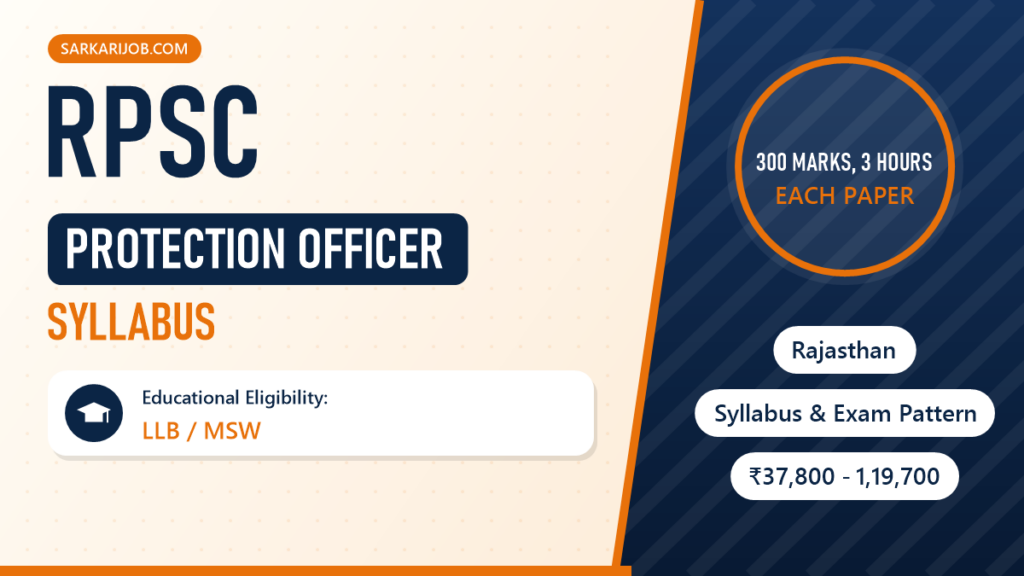
RPSC Protection Officer Syllabus and Exam Pattern 2026
Short Details of Notification
Sarkari Job
|
Exam Overview
- Based on : RPSC Advt. No. 13/Exam/Protection Officer/RPSC/EP-I/2025-26 dated 18/12/2025 and the RPSC syllabus for the Protection Officer Competitive Examination dated 02/06/2026
- Conducting Body : Rajasthan Public Service Commission (RPSC), Ajmer
- Post : Protection Officer (संरक्षण अधिकारी), Women and Child Development Department (महिला एवं बाल विकास विभाग); 12 posts in the 2025 exam
- Stages : Written Exam (लिखित परीक्षा) only; candidates are recommended in merit order of their written exam marks, with no interview stage
- Mode : objective multiple choice questions, Offline / Online, answers marked on an OMR sheet; each paper may be answered in English or Hindi, but not partly in both
- Pay : Pay Matrix Level L-11 (Grade Pay ₹4200), ₹37,800 – 1,19,700 (Rajasthan pay matrix); fixed monthly pay during probation
|
Exam Pattern |
| Paper | Subject | Time | Marks |
| Paper I | General Studies (Compulsory) | 3 Hours | 300 |
| Paper II | Social Work or Law (Optional, choose one) | 3 Hours | 300 |
- Total Marks : 600; all questions in both papers are multiple choice
- Negative Marking : 1/3 of the question’s marks is cut for each wrong answer; marking more than one answer counts as wrong
- OMR : each question has 5 options; darken option 5 for a question you do not attempt. If no circle is darkened, 1/3 of the marks is cut, and a candidate who leaves more than 10% questions blank is disqualified. 10 minutes extra are given to fill these circles
- Qualifying Marks : 40% in each paper; relaxation for Ex-Servicemen and PwD as per Rajasthan rules
|
Detailed Syllabus |
Paper I : General Studies |
Unit I : Rajasthan History, Art and Culture
- Major landmarks in the history of Rajasthan, major dynasties, their administrative and revenue system, socio-cultural issues
- Freedom movement, political awakening and integration
- Salient features of architecture : forts and monuments; arts, paintings and handicrafts
- Important works of Rajasthani literature, local dialects
- Fairs, festivals, folk music and folk dances; Rajasthani culture, traditions and heritage
- Religious movements, saints and lok devtas of Rajasthan; important tourist places; leading personalities of Rajasthan
|
Unit II : Indian History
- Ancient and Medieval Period : salient features and major landmarks of ancient and medieval India; art, culture, literature and architecture; major dynasties, their administrative system; socio-economic conditions, prominent movements
- Modern Period : modern Indian history from about the middle of the eighteenth century until the present, significant events, personalities and issues; the Freedom Struggle and Indian National Movement, its stages and contributors from different parts of the country; social and religious reform movements in the 19th and 20th century; post-independence consolidation and reorganization within the country
|
Unit III : Indian Constitution, Political System, Governance and Administrative System of Rajasthan
- Constitutional Development and Indian Constitution : Government of India Acts 1919 and 1935, Constituent Assembly, nature of the Indian Constitution, Preamble, Fundamental Rights, Directive Principles of State, Fundamental Duties, federal structure, constitutional amendments, emergency provisions, Public Interest Litigation (PIL) and judicial review
- Indian Political System and Governance : nature of Indian state, democracy in India, reorganization of states, coalition governments, political parties, national integration; Union and State executive, Union and State legislative, judiciary
- President, Parliament, Supreme Court, Election Commission, Comptroller and Auditor General, Planning Commission, National Development Council, Central Vigilance Commission (CVC), Central Information Commission, Lokpal, National Human Rights Commission (NHRC); local self government and Panchayati Raj
- Public Policy and Rights : national public policy as a welfare state, various legal rights and citizen charter
- Administrative System of Rajasthan : Governor, Chief Minister, State Assembly, High Court, Rajasthan Public Service Commission, district administration, State Human Rights Commission, Lokayukt, State Election Commission, State Information Commission; public policy, legal rights and citizen charter
|
Unit IV : Geography of World, India and Rajasthan
- World Geography : broad physical features, environmental and ecological issues, wildlife and bio-diversity, international waterways, major industrial regions
- Geography of India : broad physical features and major physiographic divisions, agriculture and agro based activities, minerals (iron, manganese, coal, oil and gas, atomic minerals), major industries and industrial development, transportation and major transport corridors, natural resources, environmental problems and ecological issues
- Geography of Rajasthan : broad physical features and major physiographic divisions; natural resources (climate, natural vegetation, forests, wildlife and bio-diversity); major irrigation projects; mines and minerals; population; major industries and potential for industrial development
|
Unit V : Indian Economy and Economy of Rajasthan
- Basic Concepts of Economics : budgeting, banking, public finance, national income, growth and development; accounting (concept, tools and uses in administration); stock exchange and share market; fiscal and monetary policies; subsidies, public distribution system; e-commerce; inflation (concept, impact and control mechanism)
- Economic Development and Planning : 5 year plans (objectives, strategies and achievements); major sectors of economy (agriculture, industry, service and trade) with current status, issues and initiatives; major economic problems and government initiatives; economic reforms and liberalization
- Human Resource and Economic Development : Human Development Index; poverty and unemployment (concept, types, causes, remedies and current flagship schemes); social justice and empowerment, provisions for weaker sections
- Economy of Rajasthan : macro overview; major agricultural, industrial and service sector issues; growth, development and planning; infrastructure and resources; major development projects; programmes and schemes, government welfare schemes for SC / ST / Backward Class / Minorities / Disabled Persons, Destitute, Women, Children, Old Age People, Farmers and Labourers
|
Unit VI : Current Affairs
- Current affairs including current sensitive issues
- Major current events and issues of state (Rajasthan), national and international importance
- Persons and places in recent news; games and sports related activities
|
Unit VII : Reasoning, Mental Ability and Basic Numeracy
- Logical Reasoning (deductive, inductive, abductive) : statement and assumptions, statement and argument, statements and conclusion, courses of action; analytical reasoning
- Mental Ability : number series, letter series, odd man out, coding-decoding, problems relating to relations, shapes and their sub sections
- Basic Numeracy : elementary knowledge of mathematical and statistical analysis; number system, order of magnitude, ratio and proportion, percentage, simple and compound interest, data analysis (tables, bar diagram, line graph, pie chart)
|
Unit VIII : General Science, Computers and Information Technology
- Basics of everyday science; electronics, computers, information and communication technology; space technology including satellites; defence technology; nanotechnology
- Human body, food and nutrition, health care; environmental and ecological changes and its impacts; biodiversity, biotechnology and genetic engineering
- Agriculture, horticulture, forestry and animal husbandry with special reference to Rajasthan; development of science and technology in Rajasthan
|
Unit IX : Hindi (सामान्य हिन्दी)
- संधि और संधि विच्छेद, सामासिक पदों की रचना और समास–विग्रह, उपसर्ग, प्रत्यय
- पर्यायवाची शब्द, विपरीतार्थ (विलोम शब्द), अनेकार्थक शब्द, शब्द– युग्म, संज्ञा शब्दों से विशेषण बनाना
- शब्द– शुद्धि : अशुद्ध शब्दों का शुद्धीकरण और शब्दगत अशुद्धि का कारण
- वाक्य – शुद्धि : अशुद्ध वाक्यों का शुद्धीकरण और वाक्यगत अशुद्धि का कारण
- वाच्य : कर्तृवाच्य, कर्मवाच्य और भाववाच्य प्रयोग; क्रिया : सकर्मक, अकर्मक और पूर्व कालिक क्रियाएँ
- वाक्यांश के लिए एक सार्थक शब्द, मुहावरे और लोकोक्तियाँ
- अंग्रेजी के पारिभाषिक (तकनीकी) शब्दों के समानार्थक हिन्दी शब्द
- सरल, संयुक्त और मिश्र अंग्रेजी वाक्यों का हिन्दी में रूपान्तरण और हिन्दी वाक्यों का अंग्रेजी में रूपान्तरण
- कार्यालयी पत्रों से सम्बन्धित ज्ञान
|
Unit IX : General English
- Tenses / sequence of tenses, voice (active and passive), narration (direct and indirect)
- Transformation of sentences : assertive to negative, interrogative, exclamatory and vice versa
- Use of articles and determiners, use of prepositions
- Translation of simple (ordinary / common) sentences from Hindi to English and vice versa
- Correction of sentences including subject, verb, agreement, degrees of adjective, connectives and words wrongly used
- Glossary of official, technical terms (with their Hindi versions)
- Synonyms, antonyms, one word substitution, forming new words by using prefixes and suffixes, confusable words
- Comprehension of a given passage
- Knowledge of writing letters : official, demi official, circulars and notices, tenders
|
Paper II (Optional 1) : Social Work |
Unit I : Social Work and Sociology
- Nature and development of social work : social work as a profession, historical development of social work, role of social worker
- Sociological concepts, human behaviour and governance : basic concepts in sociology, society, social groups, community, institution, culture, social structure, social system, stratification, social control, socialization, social change
|
Unit II : Psychology
- Basic concepts in psychology : cognition, learning, motivation, emotion, intelligence, role, collective behavior
- Relationship between psychology and social work, theories of personality
- Determinants of human behavior : heredity and environment
|
Unit III : Political Science and Human Rights
- Basic concepts in political science : state, nation, Constitution of India (features), judiciary, legislature and executive
- Human rights, social policy and social work practice : human rights (theoretical orientation), declarations, treaties and conventions, human rights in the Indian context, social policy and social work practice
|
Unit IV : Social Work with Communities
- Community as a dynamic entity
- Community work : concept, strategies and principles, the context of community work
|
Unit V : Casework and Group Work
- Social work with individuals : nature and development of casework, principles and components of casework, techniques and casework practice
- Social work with groups : understanding social groups, group work and group dynamics, group development and sites of group work
|
Unit VI : Research in Social Work
- Research methods for social work, constructing research design
- Quantitative and qualitative techniques of data collection, tabulation and data analysis
|
Unit VII : Welfare Administration and Social Justice
- Administration of welfare and development services : social welfare and development organizations, social welfare administration, strategies and mechanisms of administration
- Social justice and empowerment : dimensions of social justice, instruments of social justice, people on the margins, law and empowerment
|
Unit VIII : Families, Children, Health and Disability
- Social work with families and children : understanding family and social work with families; child development, perspectives and programmes
- Healthcare social work practice : concept of health, well-being and disease, healthcare services and programmes, healthcare social work
- Social work with persons with disabilities : disability, nature and dimensions, services and programmes, rehabilitation of persons with disabilities
- Working conditions and conditions of work, welfare measures and social response, law related to workers
|
Unit IX : Social Disorganisation
- Meaning and concept, alienation, beggary, prostitution, drug abuse, crime and juvenile delinquents, white collar crime
|
Unit X : Counseling
- Counseling theory and practice : foundation of counseling
- Counseling approaches, techniques and procedures; counseling practice in different settings
|
Paper II (Optional 2) : Law |
Unit I : Constitution of India
- Special emphasis on Fundamental Rights, Directive Principles and enforcement of rights through writs
- Functioning of High Courts and Supreme Court, Attorney General
|
Unit II : Civil Procedure and Other Acts
- Civil Procedure Code and Limitation Act (provisions generally referred to in Government offices get importance)
- Bhartiya Sakshya Adhiniyam 2023
- Protection of Women from Domestic Violence Act, 2005; Right to Information Act, 2005
|
Unit III : Criminal Procedure and Juvenile Justice
- Laws relating to Bhartiya Nagarik Suraksha Sanhita 2023
- Juvenile justice and Probation of Offenders Act
|
Unit IV : Legal Language
- Legal language and legal writing including General English
|
Unit V : Family Law (Hindu and Muslim Law)
- Concepts in family law, sources of family law in India
- Marriage and dissolution of marriage, divorce, adoption and guardianship, maintenance, matrimonial remedies
- Uniform Civil Code with special reference to personal laws
|
Unit VI : General Principles of Criminal Law
- Meaning, nature, essentials and stages of offence, general exceptions, common intention and common object
- Joint liability, criminal attempt, abetment and criminal conspiracy
- Offences against human body, offences against property, defamation, offences against girls and women
|
Unit VII : Human Rights
- Concept and development of human rights; contribution of the United Nations in the development and implementation of human rights
- Implementation of human rights in India : Protection of Human Rights Act, 1993; role of the National Human Rights Commission, State Human Rights Commission and NGOs
- Protection of marginalised groups : women, children, minorities and refugees
|
Interested Candidates Can Read the Full Notification Before Apply Online. |
Get Latest Sarkari Naukri Updates via Social Media |
WhatsApp |
Telegram |
Facebook |
Some Useful Important Links |
Download Syllabus PDF |
Click Here |
Download Notification |
Click Here |
RPSC Protection Officer Recruitment Updates |
Click Here |
Official Website |
Click Here |
 Sarkari Job Team
Updated: